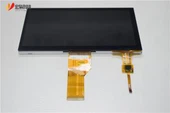

The light transmittance and clarity of the capacitive touch screen are better than the four-wire resistive screen, and of course it cannot be compared with the surface acoustic wave screen and the five-wire resistive screen. Capacitive screens reflect serious light, and the four-layer composite touch screen of capacitive technology has uneven light transmittance to light of various wavelengths, and there is a problem of color distortion. Due to the reflection of light between layers, image characters are also blurred. In principle, the capacitive screen uses the human body as an electrode of a capacitor element. When a conductor is close to the working surface of the sandwich ITO and a capacitor of sufficient capacitance is coupled, the current flowing away is enough to cause the capacitive screen to malfunction . We know that although the capacitance value is inversely proportional to the distance between the poles, it is directly proportional to the relative area, and is also related to the insulation coefficient of the medium. Therefore, when a large area of the palm or a hand-held conductive object is close to the capacitive screen instead of touching, it can cause the capacitive screen to malfunction. In wet weather, this situation is particularly serious. Hold the display with the palm close to the display 7 cm Within 15 cm of the body close to the display can cause the capacitive screen to malfunction. Another disadvantage of capacitive screens is that there is no response when touched with gloved hands or holding non-conductive objects. This is because a more insulating medium is added. The main disadvantage of the capacitive screen is drift: when the ambient temperature and humidity change, and the environmental electric field changes, it will cause the capacitive screen to drift and cause inaccuracy. For example: the temperature of the monitor will rise after power-on, which will cause drift: the user touches the screen while the other hand or the side of the body is close to the monitor; larger objects near the capacitive touch screen move and drift back. Will cause drift; the reason for the drift of the capacitive screen is due to technical inadequacy. Although the environmental potential surface (including the user's body) is far away from the capacitive touch screen, it is much larger than the area of the finger. They directly affect the determination of the touch position . In addition, in theory, many relationships that should be linear are actually non-linear, such as: the total amount of current drawn by people with different weights or different degrees of finger wetness is different, and the change of the total current and the change of the four sub-currents It is a non-linear relationship. The four-corner custom polar coordinate system adopted by the capacitive touch screen has no origin on the coordinates. After drifting, the controller cannot detect and recover. Moreover, after the completion of 4 A/D, there are four points. The calculation process from the value of the flow rate to the X and Y coordinate values of the touch point on the Cartesian coordinate system is complicated. Since there is no origin, the drift of the capacitive screen is cumulative, and calibration is often required at the work site. The outermost silica protective glass of the capacitive touch screen is very scratch-resistant, but it is afraid of nails or hard objects. If a small hole is knocked out, it will damage the interlayer ITO, whether it is damage to the interlayer ITO or during installation and transportation. With the ITO layer on the inner surface, the capacitive screen cannot work normally.
Strong anti-interference performance
Supports gloved & water touch
Compatible with explosion-proof glass
Sunlight-readable outdoors
Highly customizable
Stable quality & long product lifecycle